
How Cell Fusion C became a skincare staple beyond the clinic
 15min
15min
 AI Summary
This summary was generated by AI. Please refer to the full article for accuracy.
AI Summary
This summary was generated by AI. Please refer to the full article for accuracy.
Founded in 2001 to address the needs of sensitive skin after laser treatments, Cell Fusion C developed sunscreens and BB creams with dermatologists before expanding from clinics and hospitals into OLIVE YOUNG in 2017. Under CEO Jinsoo Lee, the brand has built products around research and specific skin concerns, including cooling masks and barrier-focused skincare, and is now exploring K-derma’s potential in the U.S. through Sephora.


From sunscreens and cooling masks to barrier-focused skincare, Cell Fusion C has built its reputation around a simple starting point: understanding what skin needs in the moments when it is most vulnerable.
The story began in 2001, as laser treatments were becoming increasingly common at dermatology clinics in Seoul’s Gangnam district. Skin could be particularly sensitive after a procedure, making sun protection essential. Yet sunscreens formulated with sensitive, post-treatment skin in mind were not widely available at the time, and leaving the clinic with a visibly flushed face could be uncomfortable.
Cell Fusion C saw an opportunity in this gap. Working closely with dermatologists, the brand developed sunscreens designed to be comfortable on sensitive skin after treatments, along with BB creams that could naturally even out the appearance of redness. The products were built around a clear need: helping people care for their skin immediately after a dermatological treatment, when it was at its most sensitive.
From its beginnings in dermatology clinics and hospitals, Cell Fusion C gradually built a reputation for professional skincare. The brand has since grown into a familiar name in OLIVE YOUNG’s sun care category, while expanding its expertise into products that address everyday skin concerns, from cooling to skin barrier care. Today, that same expertise is reaching consumers beyond Korea.
We spoke with Jinsoo Lee, CEO of Cell Fusion C, who has spent four decades in the cosmetics industry, to explore how the brand has brought the expertise it developed in dermatology into consumers’ everyday skincare routines.
Our most important marketing is research
When Lee took over Cell Fusion C in 2015, he brought with him nearly three decades of experience across the cosmetics industry. Since entering the industry in 1986, he had worked across manufacturing, product planning, international business, and domestic sales. After joining Cell Fusion C, one of his first priorities was establishing a dedicated research center.
“From the beginning, I believed that the most important marketing our company could do was through research,” Lee says. “Building customer trust through the quality of our products was the most important thing.”
Working with dermatology clinics required a different approach to product development. Simply saying that a product contained good ingredients was not enough to earn the trust of medical professionals. Cell Fusion C needed to be able to explain what ingredients and formulations it used, how they performed on the skin, and what data supported those results.

The company therefore invested in building its own body of evidence. It researched proprietary ingredients and formulations, developed products in collaboration with dermatologists, and worked with university hospital professors to design clinical studies. The resulting research was also shared through academic papers and presentations.
One area Cell Fusion C has studied extensively is the skin barrier. By researching the balance of skin pH, moisture, and lipids, the company has accumulated expertise in ingredients and formulations focused on maintaining healthy skin. That process of identifying specific skin concerns with experts and validating product performance continues to shape the brand today.
For Lee, this research-driven approach was never separate from the brand itself.
“Especially in the beginning, we needed to have the evidence to support what we were saying,” he explains. “That meant investing in our own research and building products based on what we learned.”
The next challenge was finding a way to bring that expertise beyond the clinic and into the hands of more consumers. And, in 2017, Cell Fusion C entered OLIVE YOUNG.
From clinic-only sunscreen to OLIVE YOUNG

At the time, Cell Fusion C’s primary channel was dermatology clinics and hospitals. The brand was familiar to people who had undergone dermatological treatments, but it was not yet something consumers could easily encounter in their everyday lives.
That began to change when an OLIVE YOUNG merchandiser took notice of Cell Fusion C’s sunscreens.
For Lee, the opportunity came with an important consideration: how could the brand expand its reach while preserving the expertise and trust it had built through years of working with dermatology professionals? After careful consideration, he chose to broaden the brand’s points of contact with consumers.
“We wanted more people to be able to experience what we had developed through our work with clinics,” Lee says. “The question was how to bring that expertise into a channel where consumers could discover and choose products for themselves.”
The first product to make the transition was the Laser Sunscreen. Its starting point was the same as Cell Fusion C’s original products: skin after laser treatment.
Because it was designed for sensitive skin, the sunscreen needed to provide reliable UV protection while feeling comfortable on the skin. It also needed to maintain its performance in the heat and humidity of summer, when sweat and excess oil can make sunscreen more difficult to wear.
But bringing a product developed for the clinic into an everyday retail setting called for more than simply changing where it was sold.
In a clinic, a dermatologist can explain the product and its benefits directly. At OLIVE YOUNG, consumers encounter it alongside countless other products, making their own comparisons and choices. Cell Fusion C therefore worked closely with OLIVE YOUNG’s merchandising team to reconsider everything from size and price to product configurations.
The packaging was also designed to reflect the brand’s clinical heritage. Inspired by the stainless-steel trays used to hold medical instruments, the design offered a visual reminder of where Cell Fusion C came from.
The goal was to preserve the expertise the brand had built in dermatology while making its products easier to discover and experience as part of an everyday skincare routine. From there, Cell Fusion C continued to expand its sun care range, developing products around different skin concerns and preferences, including hydration and tone correction.
A partnership beyond retail
The relationship with OLIVE YOUNG also gave Lee a new perspective on what a retail partnership could look like.
Ahead of an important decision for the brand, he once asked OLIVE YOUNG’s merchandising team for their thoughts. Instead of a brief response focused solely on sales, he received a detailed two-page reply outlining the team’s thoughts on the brand’s direction.
“It wasn't simply about whether sales were going well or not,” Lee recalls. “They gave us very specific thoughts on where they thought the brand should go. We actually printed out the email and read it together as a team.”
For Lee, it was a moment when OLIVE YOUNG felt like more than a retail channel. The team was thinking alongside Cell Fusion C about the brand’s future.
That partnership became an important part of Cell Fusion C’s evolution: maintaining the expertise and heritage built in dermatology while creating more opportunities for consumers to experience the brand in their everyday lives.
And that evolution did not stop with sunscreen.
From firefighters’ “hot skin” to a cooling mask
Around 2018, Lee happened to see firefighters resting after battling a fire. They had been working in intense heat, and the effects were still visible on their faces and skin.
The scene gave him an idea for a cooling mask. “I wondered what would happen if we made a mask that felt incredibly cooling,” Lee says. “I thought it could help quickly ease the sensation of heat on overheated skin.”
That idea became Cell Fusion C’s cooling sheet mask, which the company later donated to fire stations.
The product was not initially launched with a major marketing campaign. Instead, people who tried it at OLIVE YOUNG began sharing how immediately cooling it felt. The sensation was noticeable from the moment the mask was applied, and word of mouth followed.
As toner pads emerged as another popular way to care for the skin, Cell Fusion C extended the cooling experience into a pad format.
For Lee, the cooling mask remains one of the brand’s standout products, not simply because of its popularity, but because of what it represents about Cell Fusion C’s approach to product development.
The process begins by identifying a specific skin concern and then drawing on the expertise the company has accumulated to develop a practical solution.
From sunscreen for sensitive skin after laser treatments to cooling products for overheated skin and skincare focused on the skin barrier, the products may be different, but they share the same starting point: a real skin concern.
“Ultimately, that's how we think about new products,” Lee says. “We start by asking what skin concern we want to address, and then think about how our expertise can provide a solution.”
That philosophy also shapes how the brand communicates with consumers.
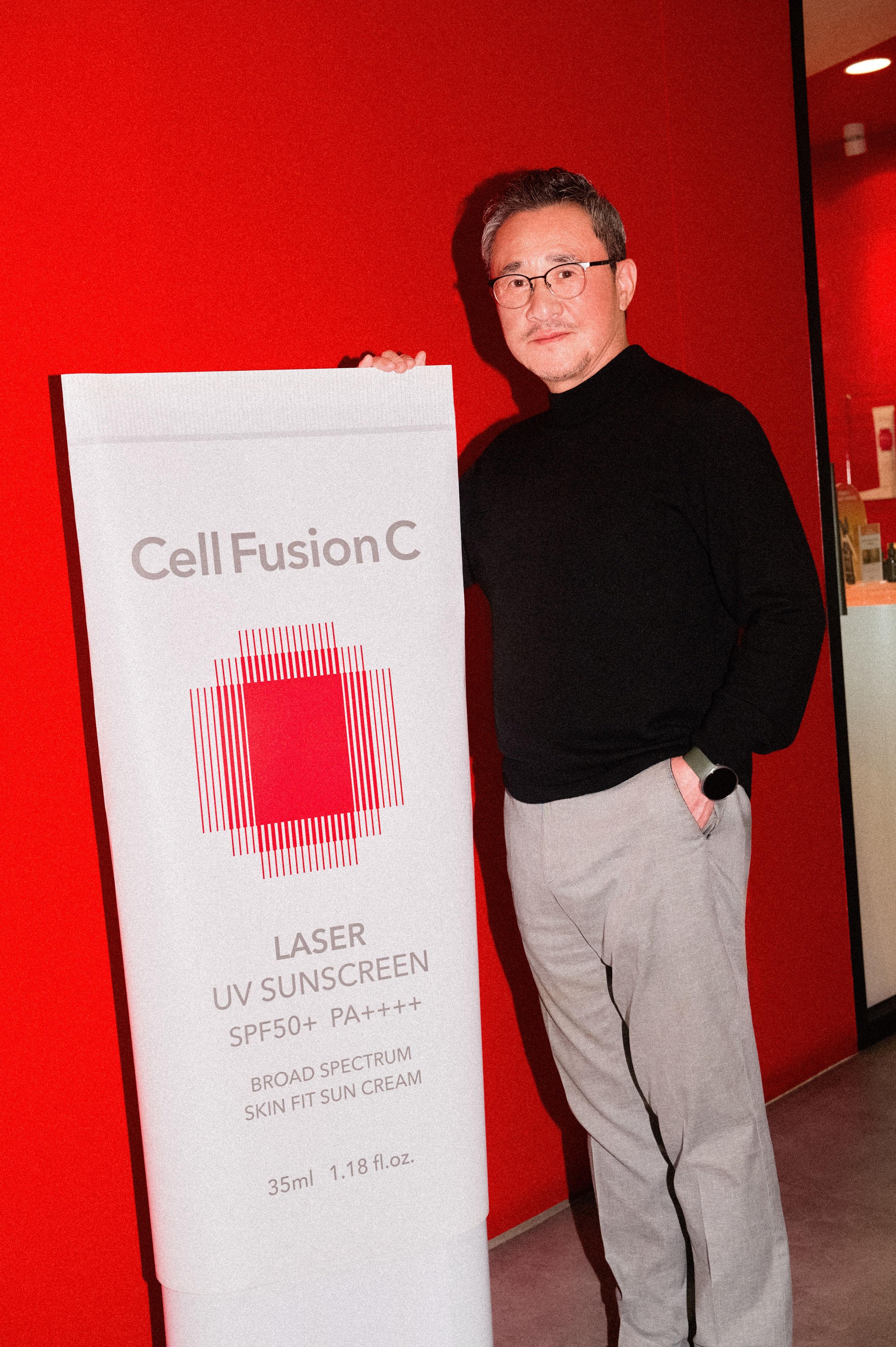
“We can't take all the complex logic and data we've developed for hospitals and explain it to everyday consumers like a textbook,” Lee says. “We want to bring the benefits we've thoroughly tested and built up through our work with clinics, while finding ways to communicate them in a simpler and more accessible way.”
In other words, the science stays rigorous, while the experience of using the product becomes simpler.
That has been Cell Fusion C’s approach for more than two decades: identify the skin concerns people encounter in everyday life, apply the research and expertise developed through dermatology, and turn that knowledge into products people can easily incorporate into their routines.
Seeing the potential of K-derma in the U.S.
More recently, Cell Fusion C has begun seeing the potential of this approach in the United States.
In August, the brand partnered with OLIVE YOUNG to enter Sephora in the U.S. What surprised Lee was how quickly the cooling mask and cooling pad gained traction, with both products receiving additional orders soon after launch.
For Lee, the U.S. market offered an opportunity to observe not only how consumers were responding to Cell Fusion C, but also how interest in K-beauty was evolving more broadly.
During a recent visit to OLIVE YOUNG’s first U.S. store in Pasadena, he saw a long line stretching outside the store. Unable to make it inside, he ended up taking a photo from outside before leaving.
What stood out to him was the level of attention consumers were paying to products and their ingredients.
“Customers in the U.S. are also looking closely at ingredients and efficacy and choosing products based on their own skin concerns,” Lee says. “It made me confident that the strengths of Korean derma cosmetics, which are rooted in dermatological research, can resonate with consumers there as well.”
For Lee, the opportunity for K-derma goes beyond individual products. Korean derma cosmetics can also introduce consumers to a broader approach to skincare grounded in research, professional expertise, and specific skin concerns.
Platforms such as OLIVE YOUNG can help make that expertise easier to discover by bringing established brands and products together in one place and connecting them with global retail channels.
“There are many Korean derma cosmetics brands whose products are rooted in years of research and specific customer skin concerns,” Lee says. “If these brands can be introduced together through OLIVE YOUNG and connected with global retail channels, I believe K-derma cosmetics can establish itself as a strong category in its own right.”
For Cell Fusion C, the journey from dermatology clinics to everyday skincare continues to be guided by the same principle that shaped the brand from the beginning: start with a real skin concern, build the expertise to understand it, and turn that knowledge into products that people can use every day.